VirelaiOS
VirelaiOS is a from-scratch AArch64 operating system. It boots under real UEFI firmware on Apple silicon, hosted by Apple's Virtualization.framework (macOS 27 or newer). It is not Linux, not Unix, and not QEMU — no libc, no POSIX, no existing guest OS, no emulator anywhere in the boot path.
The guest is written in freestanding Zig without libc or POSIX; the host launcher is Swift. The kernel seizes the machine itself: it ends UEFI Boot Services, installs its own page tables, and drives the hardware directly through virtio and MMIO drivers.
The name is a joke. The engineering is not. Every subsystem this site describes is either verified deterministically or live-gated on real hardware — see Evidence & testing.
Current status
Milestones through M104 are landed or closed — plus M106 (the
flintd host server, shipped in its own repo). Six arcs are open on the
ledger — M96 (the Zig 0.17.0 port's cards are all landed; its owner
acceptance run is the last step), M100 (a journaled guest filesystem on
virtio-blk: the RW driver, the runner's --data-disk attach, mkfs.vlfs,
the /disk mount, and the journaled write path are on main; fsck and the
data-root cards are in flight), M101 (signed software distribution:
FLINT.ELF's FLINT-SYNC/1 remote verbs, the publisher keyring, and the
STORE.ELF install seam are on main; update/rollback is in review),
M105 (the Zig FLINT host client — flintd already shipped), M107
(the in-guest dev loop, complete through M107e: GODIFF.ELF was authored,
built, and pushed entirely in-guest; acceptance is in flight), and M108
(host integration: the bidirectional clipboard, host→guest file drop, and
seat→macOS notify-out are all on main; acceptance is open). The table
below is the first 31 milestones; the full table through M106 is on
Roadmap & status and the canonical tracker is
docs/status.md.
| Milestone | What it is | Status |
|---|---|---|
| Boot → kernel proper | UEFI boot pipeline, handoff, ExitBootServices, identity-map MMU, polled serial console |
Done |
| Monitor | Interactive virelai> kernel monitor (shell, filesystem, reboot/shutdown) |
Done |
| Userspace | Allocator, GIC + timer, scheduler, EL0 + syscalls, uaccess, address spaces, exec | Done |
| Processes | Entropy/CSPRNG, process registry, IPC, wait, kill, concurrent programs | Done |
| Networking | virtio-net, ARP, IPv4/ICMP, UDP, DHCP, TCP, NAT | Done |
| Graphics | virtio-gpu framebuffer, text, Road Pops terminal, Driving Award window manager | Done |
| Input | USB XHCI, HID enumeration, keyboard events feeding the terminal | Done |
| Usability & HIG | ADR 0008: grouped help, line editing + history, one error contract, window chrome, sysinfo, persistent settings |
Done |
| Events | Per-process event queues: keyboard/pointer/window events to focused EL0 apps (sys_poll_event/sys_wait_event) |
Done |
| User filesystem ABI | Per-process file table, host-backed /host API, file syscalls (slots 23–27), storage utilities |
Done |
| Desktop platform | ADR 0011: zero-heap ui.zig widget toolkit; the current shipping seat is GOTABWM.ELF with Go clients (GOCALC.ELF, NOTE.ELF, GOTOP.ELF, GOFILES.ELF) |
Done |
| Network apps | TCP syscall seam (slots 30–33), RFC 1035 DNS, TCP.BIN/GOFETCH.ELF, and Go network clients (GOPING.ELF, GONETSTAT.ELF, GODNS.ELF, GOTRACEROUTE.ELF) |
Done |
| Files & applications | Mutating filesystem seam (slots 34–37), APPS.TXT manifest, graphical data browser (now GOFILES.ELF), desktop composition |
Done |
| Shared services | Clipboard + app timers + composition capstone + isolation hardening (slots 38–41) | Done |
| Audio | virtio-snd, PCM playback, beep, the EL0 audio seam (slots 42–45), JINGLE.BIN + the boot chime + CHIME.BIN |
Done |
| Internals consolidation | Multi-segment user images, guard pages, measured pools (issues #190–#193) | Done |
| Desktop completeness | Widget depth, window management, app upgrades, rich interactions, system polish (M17 + Arc1–5) | Done |
| Terminal & shell depth | Scrollback, selection, search, persistent history, colors, scripting (M18) | Done |
| Shell programming | Pipes, redirection, environment variables, functions, substitution, arithmetic, conditionals (M19) | Done |
| Text rendering & Unicode | Font sizes, Unicode glyphs, search, chrome, tabs (M20) | Done |
| Window management depth | Tiling, master-detail, minimize, alt-tab, notification center, focus rings (M21) | Done |
| Developer tools | ELF loader, assembler, symbols, disassembler, strace (M22) | Done |
| The text editor | EDIT.BIN with undo/redo, goto, tabs, syntax, console split (M23; the Zig editor was retired — Go GOEDIT.ELF/NOTE.ELF) |
Done |
| CALC grows up | Programmer mode, memory, units, constants, history (M24) | Done |
| File manager depth | du, sort, overwrite/conflict, path copy (M25) | Done |
| Network experience | ping, netstat, traceroute, HTTP fetch display, offline preflight (M26) | Done |
| Desktop polish | G1–G30: splash, wizard, about, previews, sounds, sysmon, tooltips, audits, dogfood (M27) | Done |
| Symmetric multi-processing | A second CPU core online via PSCI, per-core schedulers, spinlocks, GICv3 IPIs (M28) | Done |
| VM depth | Demand paging, copy-on-write, anonymous sys_mmap/sys_munmap (M29) |
Done |
| Dynamic linking | Freestanding LD.SO + LIBUI.SO/LIBFONT.SO, W^X multi-aperture isolation (M30) |
Done |
| Dyn-linking ecosystem | CALC.ELF/NOTEPAD.ELF/FILE.ELF/DESKTOP.ELF, runtime dlopen/dlsym (M31) |
Done |
The boot default is the Go seat. A single boot autostarts GOTABWM.ELF,
which hosts Go EL0 clients — the shell GOSH.ELF, the editor NOTE.ELF, the
calculator GOCALC.ELF, the browser WEB.ELF — as tabs over the WM_RPC
contract; Zig TABWM.BIN is retained by decision (ADR 0034) as the
settings set wm tabwm fallback. M71 seat honesty and M72 Charm TUI have
closed since — read
docs/status.md
for what is open today instead of a date-stamped claim from this page. The Go
toolchain already builds and runs programs in-guest (live-selfhost-go), and
GOBUILD.ELF drives that toolchain through a multi-package import graph with
named refusals (live-gobuild).
What runs today
A single boot of VirelaiOS gets you, in order:
- A UEFI boot loader that hands off to a freestanding kernel.
- A live interactive monitor (
virelai>prompt) over the serial console. - A graphical framebuffer with a real terminal on screen — Road Pops.
- A window manager — Driving Award — compositing a terminal and a live clock overlay.
- EL0 user programs, exec'd from the host share, running as real processes with a syscall ABI of 88 implemented slots (0–87 of a 128-slot table) covering IPC, windows, files, events, process control, TCP, filesystem mutation, clipboard, app timers, audio, pipes, fonts, ping, net-stats, anonymous memory, native sockets, and the observability/pid surface.
- Networking from raw Ethernet frames up through ARP, IPv4/ICMP, UDP, DHCP,
and TCP — client and passive-open server (
GOHTTPD.ELFserves the guest's own files over HTTP/1.1; the ZigHTTPD.BINwas retired in M71l) — plus an RFC 1035 DNS resolver. - Two CPU cores: SMP scheduling with spinlocks and GICv3 inter-processor interrupts.
- Dynamic executables:
CALC.ELF/NOTEPAD.ELF/FILE.ELF/DESKTOP.ELFlinked at runtime byLD.SOagainstLIBUI.SO/LIBFONT.SO, plusdlopen/dlsymplugin loading — zero libc anywhere. - USB keyboard input, enumerated over a real XHCI controller, typing into the terminal.
- A graphical desktop: the
GOTABWM.ELFseat with a working calculator (GOCALC.ELF, which was ZigCALC.BIN), a persistent text editor (NOTE.ELF, which was ZigNOTEPAD.BINuntil M66c), a click-to-kill process monitor (GOTOP.ELF, which wasTOP.BIN/SYSMON.BINuntil M71g), and a file browser over the host share (GOFILES.ELF). - Userland network applications: an HTTP client (
GOFETCH.ELF, which replaced retiredFETCH.BIN), an in-guest HTTP/1.1 web server (GOHTTPD.ELF; the ZigHTTPD.BINwas retired in M71l) that serves the guest's own files to the host, and the Go network diagnostics (GOPING.ELF,GONETSTAT.ELF,GODNS.ELF,GOTRACEROUTE.ELF). - Keyboard, pointer, and window events routed to focused applications, so an EL0 program runs an interactive event loop.
- A shared clipboard (copy/cut/paste across text apps) and per-process
application timers that post
TIMERevents instead of spin loops. - Sound: a virtio-snd device, PCM playback from EL0, a boot chime, and a melody app that plays Twinkle Twinkle Little Star.
- A disk of its own (opt-in):
--data-disk <img>attaches a second virtio-blk function and the kernel mounts amkfs.vlfs-formatted VLFS volume at/disk— journaled writes commit through a real fsync barrier (M100d, gatelive-vlfs-write);fsck.vlfsand opt-in data-root adoption are still in flight. - A bridge to the Mac (opt-in):
--host-clipboardsyncs the guest clipboard with a named pasteboard through HMAC-signed share files, seat-mediated and byte-silent when off;--host-droplands host files in/host/INBOXwith a seat toast and mime dispatch;--host-notifycarries seat toasts out to macOS banners;FLINT.ELFclones/pulls/pushes signed source against a hostflintdover FLINT-SYNC/1.
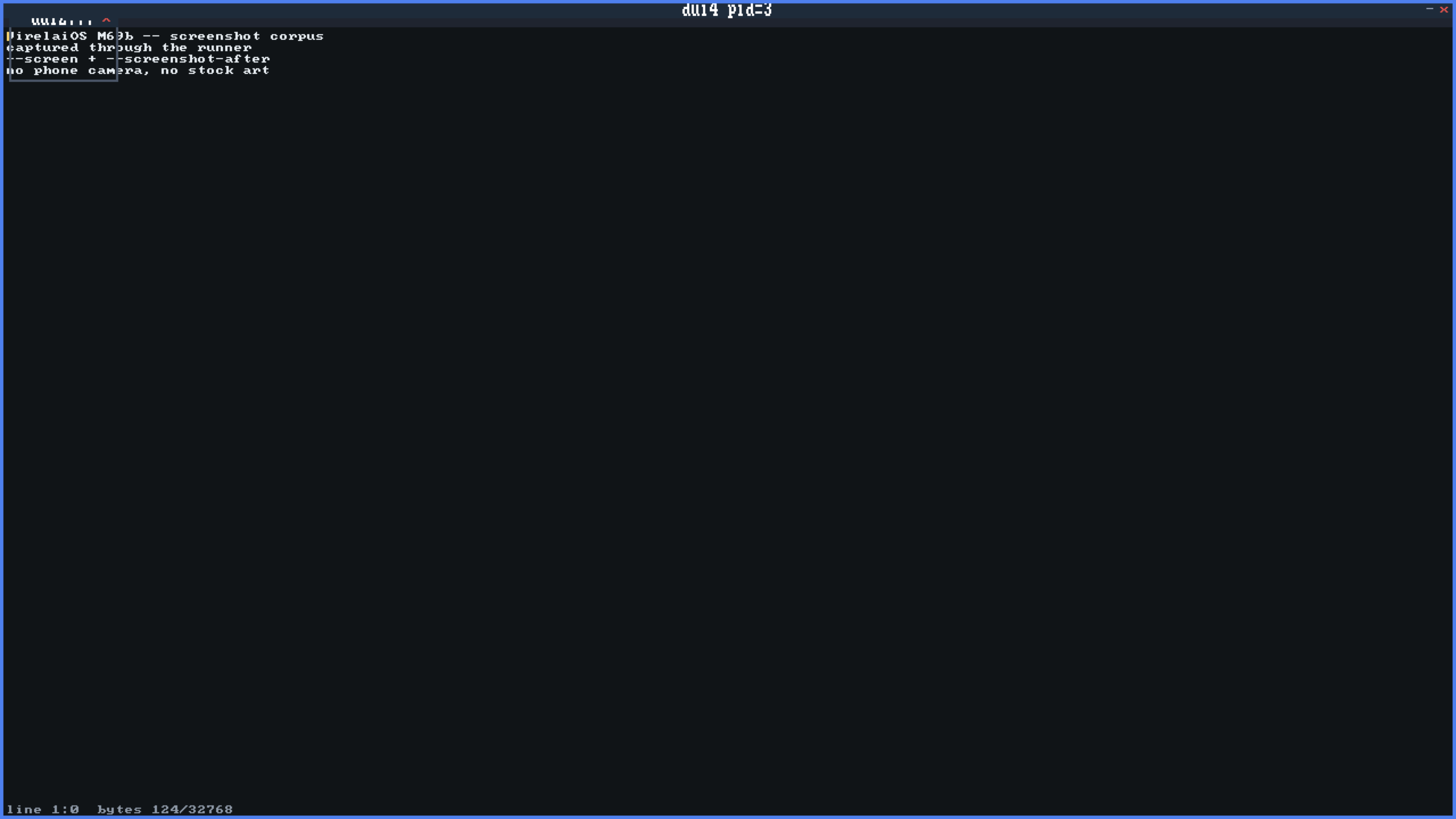
A live boot, captured by the runner's own framebuffer path — one boot,
--screen + --screenshot-after waiting on a guest marker, 2560x1440 (the
1280x720 scanout at 2x). The default Go seat GOTABWM.ELF is hosting the
Go editor NOTE.ELF, which loaded /host/notes.txt out of the host share. No
phone camera and no stock art; docs/testing.md has the recipe.
 |
 |
 |
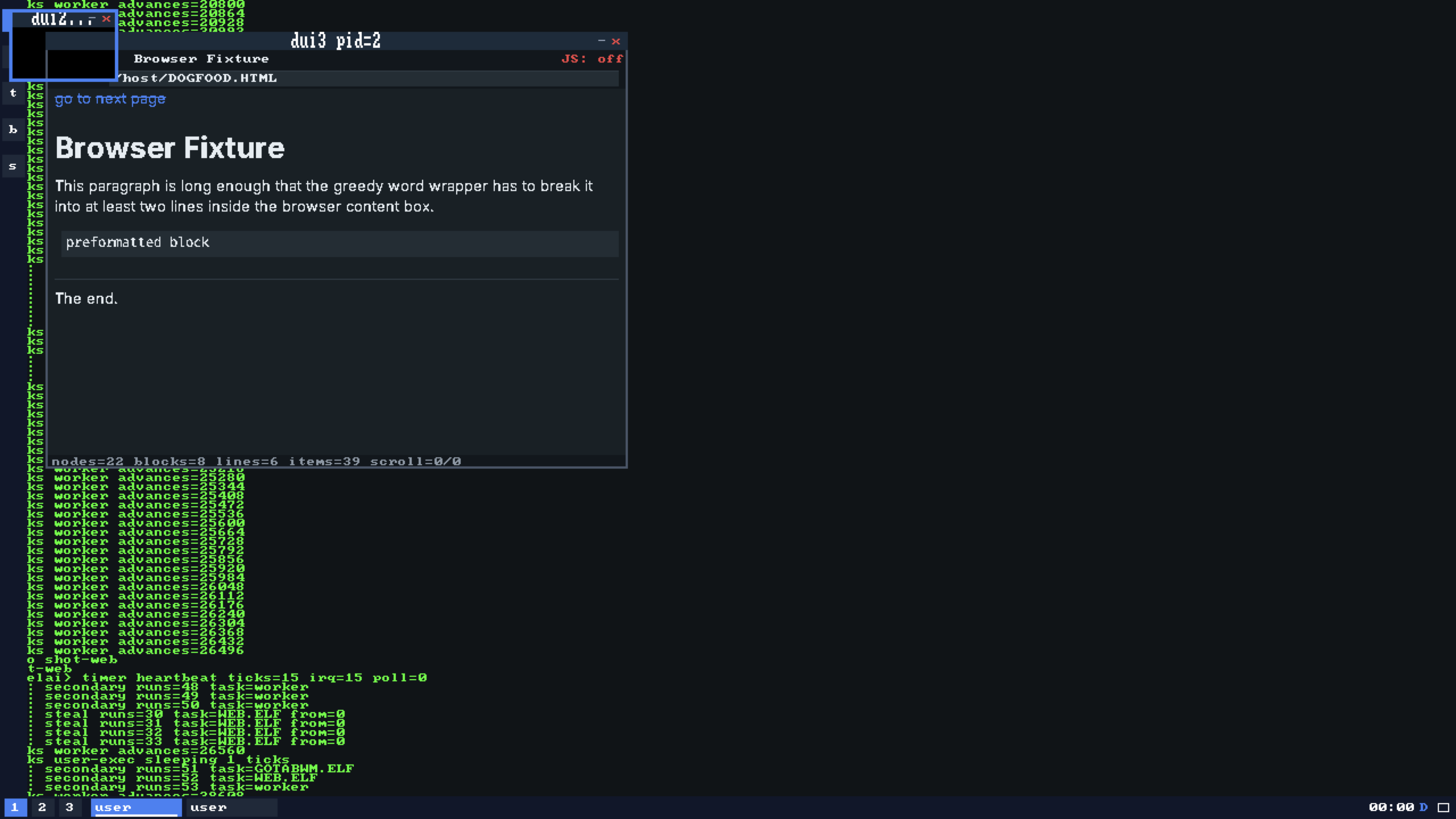 |
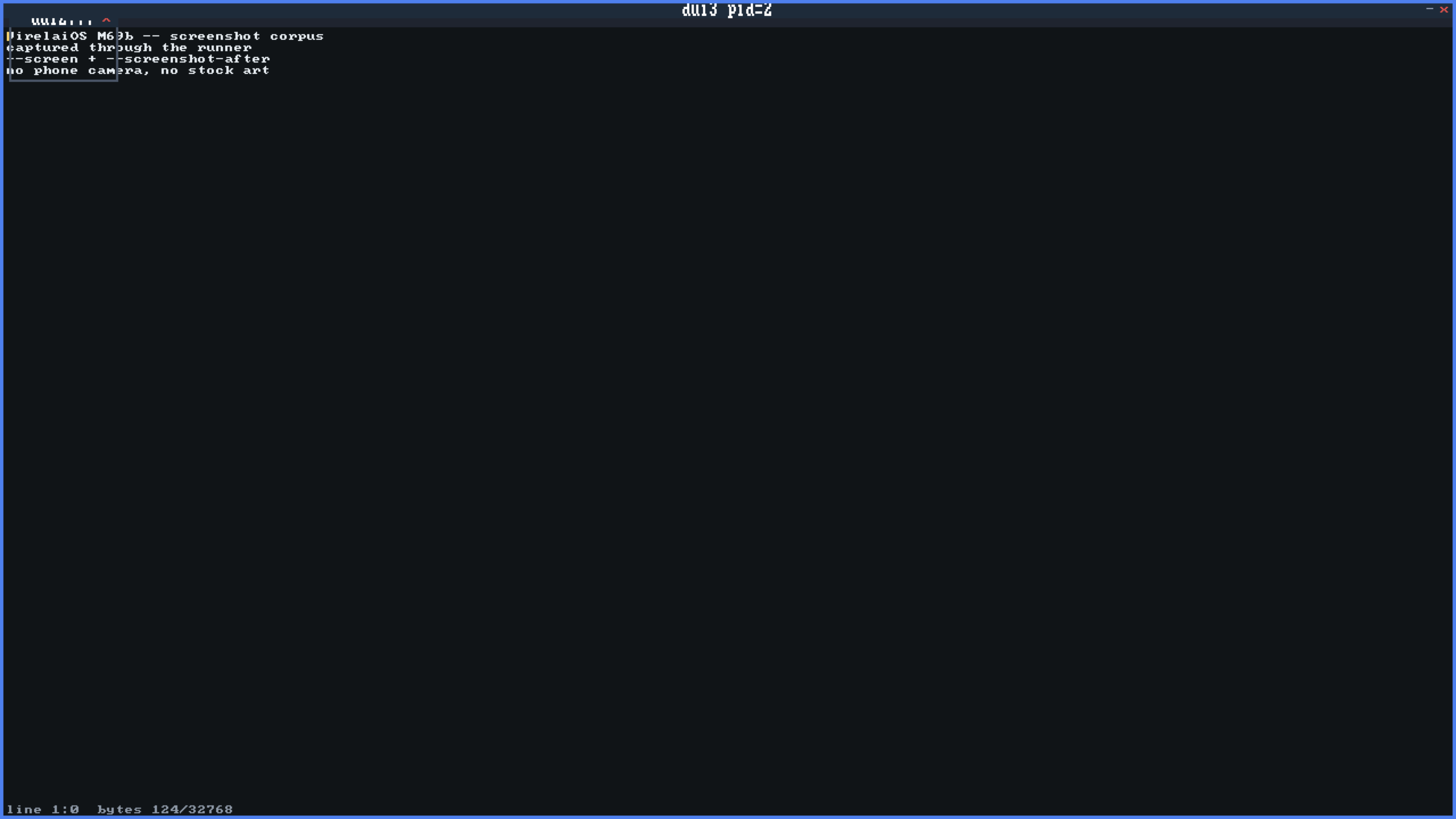
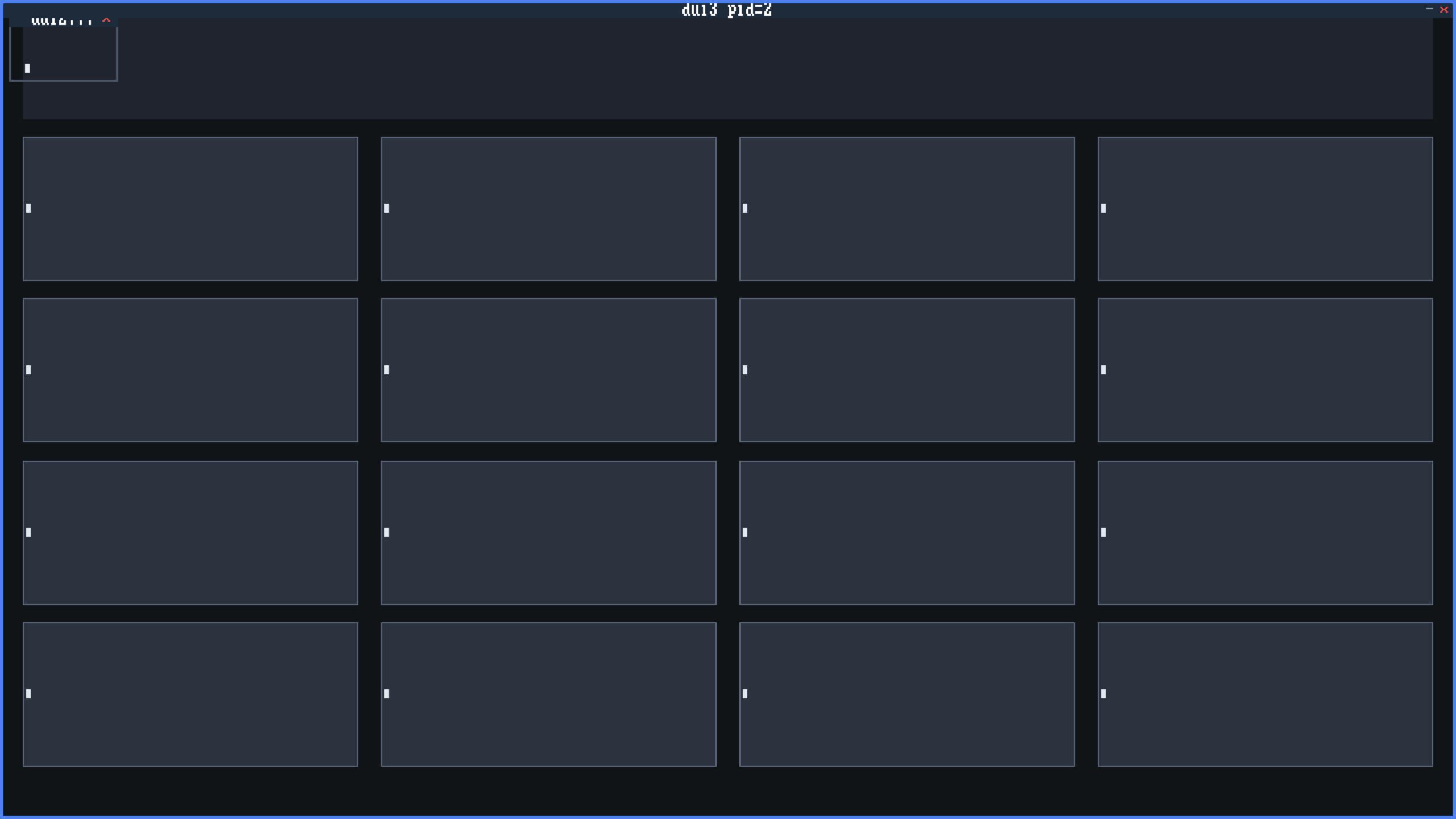
The rest of the corpus, captured through the same path, one boot each: the
shell GOSH.ELF, the editor, the calculator, and the browser rendering a page
in-guest. The pixels exposed two things the markers could not see. The first —
GOSH.ELF's tab holding no pixels while the shell's own markers were green
(observed on
#1529) — was
diagnosed and fixed by M69g
(#1558): the
seat's own client-death probe window painted its chrome over the tab's first
line, a band holding 55 terminal-green pixels before the fix and 578 after, and
go-dogfood boot 03 now fails on a blank tab. gosh.png above is therefore a
capture from before that fix. The second — kernel console text on the
scanout wherever no window covers it — is still true and still asserted by
nothing. Regenerate them with docs/testing.md; the PNGs are the pinned
fixtures, the serial logs are not committed.
What it runs on
- Host: Apple silicon, macOS 27 or newer, Apple's Virtualization.framework.
- Guest: AArch64, freestanding Zig (pinned Zig 0.17.0), no libc.
- Not supported: Linux, Unix, QEMU, x86, any other emulator. There is deliberately no QEMU path.
Start here
- Getting started — build it, run it, what you need.
- Architecture — how the kernel and its subsystems fit together.
- Current capabilities — what actually works today, subsystem by subsystem.
- Roadmap & status — what has landed and what comes next.
- Project names & lore — what "Road Pops" and "Driving Award" mean.
- Evidence & testing — how a claimed feature is proven to work.
Who this is for
Someone who looks at an operating system called VirelaiOS and still wants to know how the MMU handoff works, how the compositor repaints, or how a DHCP lease is renewed — and who appreciates that the answer comes with a gate and a claim number instead of a screenshot and a shrug.